Applied Neuroscience Strategist, professional Biohacker, Science Fiction author, reluctant Transhumanist, father and husband.
Book Review of We Are As Gods
In the current year, it certainly feels like we're all hurtling into a Dystopian cyberpunk future. Doesn't it?
Being chauffeured through a decaying urban center in a self-driving taxi is no longer an unsettling novelty. Your smartwatch vibrates as you doomscroll videos of soldiers fleeing drones across a forlorn battlefield, warning you that your heart rate variability is non-optimal. You take Nootropic cognitive enhancers for the edge you desperately need at work; hopefully the soulless megacorporation you work for won't replace you with AI agents. An ad pops up for the exact thing you mentioned to your girlfriend, in bed last night, while you thought your phone was off.
It's not just you; it's getting weirder out there—we're just a few holidays away from your socially awkward cousin bringing a robot girlfriend home. (Yes, I just em-dashed—UNAPOLOGETICALLY—I em-dashed before AI did and will continue to dose my hyphens with Viagra whenever I damn well please).
For decades, science fiction has issued us a warning: Don't succumb completely to the siren song of technology. A warning we've collectively failed to heed. That siren song serenades us with the promise of abundance. Abundant energy, food, information, and health. Abundance that might just be... for all of us.
Like you, I don't quite doomscroll, but often find myself mesmerized by and bemoaning the techno-absurdistan of modernity. It seems like everything, everywhere is getting worse--technology is making life for us humans too weird, too fast. But maybe the popular pessimism about progress (pervasive in nearly any media we consume and then confirmed by our anecdotal experiences) is dead wrong. As a pragmatic realist who leans optimistic when I can, I wanted a dose of optimism about the future, so I cracked open We Are As Gods, A Survival Guide for the Age of Abundance, by Peter H. Diamandis (whose face will probably appear if you do a Google: techno-optimist) and Steven Kotler, whose work on flowstate has been of keen interest to me as a Biohacker.
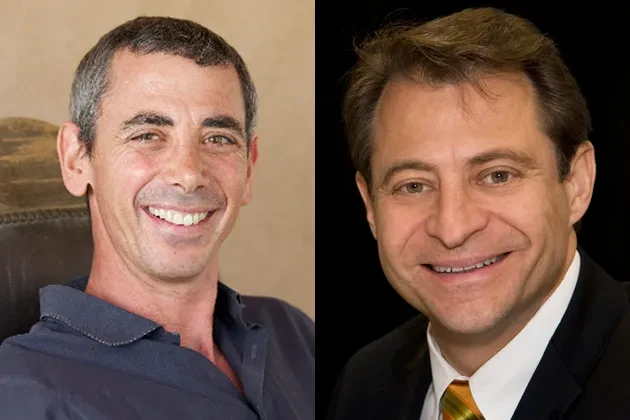 They look... normal enough
I got the dose of optimism I wanted from We Are As Gods, and I'll second-hand deal it to you here. But I got more: inspiration to endure and aspire because--spoiler alert--the age of abundance is not for all, but for the avaricious.
We are as gods
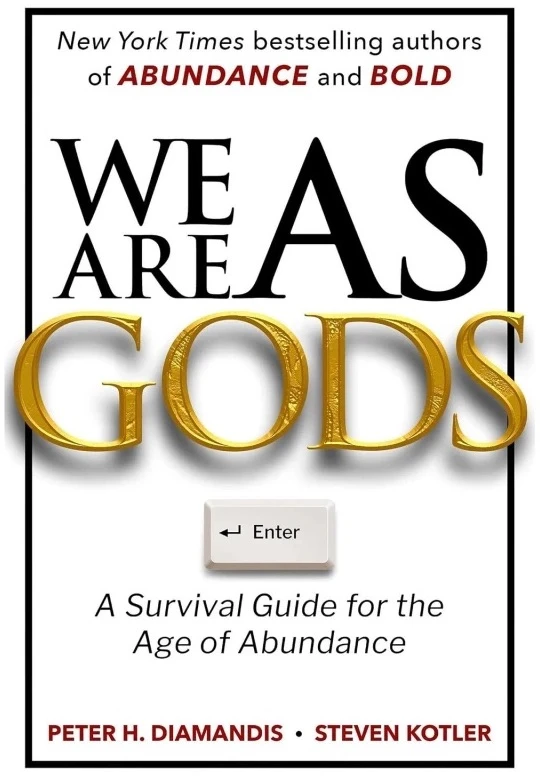
Yes, really, as gods—lowercase g because the book opens with a comparison of dozens of godlike powers from our mythology to what modern technology now enables. Omniscience (all-knowing): you've now got that in your pocket with Google and the AI assistant on your phone. Omnipresence: as I broadcast my words, image, and voice to you wirelessly via the internet, I'm, in a sense, present there with you. The blind are made to see, and the deaf hear via neural implants. Resurrection of the dead--happens in hospitals all the time. And even immortality, an attribute long reserved for deities and demigods, is increasingly within the grasp of mere humans (take your NMN!)
Diamandis and Kotler introduce us to the abundance paradox...
Each new solution unleashes a host of new problem. Only now, it’s accelerating. In the twenty-first century, the issues of abundance aren’t arriving in four thousand years or even forty. Try forty days. That’s about how long it took for social media to impact mental health. For AI to fake voices. For large language models to flood the web with synthetic noise.
And ask us: What happens when abundance is the rule rather than the exception?
Imagine a “post-scarcity world,” where nearly anything and everything becomes available through the combined
Here's where we have to get clear-eyed about human nature. In the post-scarcity world, too many will succumb to comfort. And comfort, I contend, is toxic. Modern society is plagued by diseases of comfort and eerily mirrors the darker days of Calhoun's famously dystopian Mouse Utopia experiment, which is described...
By day 600, normal social behaviors were breaking down. Infant mortality approached 100 percent in some areas, as mothers either abandoned their nests or attacked their young. Violence became random, unmoored from the usual patterns of territorial defense. Cannibalism was observed. Sexual behaviors became confused and nonreproductive. On day 660, Calhoun noted: “Population growth has stopped entirely, even with abundant space in the lower areas. They’re crowding into population centers. Reproductive behavior has virtually ceased.”
So, is more technology, hastening the acceleration of these accelerationist times, the solution?
Let's turn our attention to the focus of my new podcast, Limitless Intelligence...
AI: One Billion Times Smarter
 Who's outsmarting who?
Artificial intelligence is more than a "trend"—it's the birthing of new intelligent species that we will have to share this world with. The authors, who I believe are highly invested in the AI space, present a balanced view of its promise and perils. They comment on the velocopedic pace of the space...
The raw computing power driving AI forward has been compounding every three months since 2022. That’s Moore’s law on steroids. In 2024, AI was a million times more powerful than it was in 2022. By 2030, the numbers experts toss about are nearly incomprehensible.
We know the blistering pace of AI development demands that we consider a future with machines a billion times more intelligent than we are—which, it’s worth noting, is the rough equivalent of the difference between a human and a hamster.
Arthur C. Clarke on AI
In 1964, less than a decade after the Dartmouth AI conference, science fiction author Arthur C. Clarke foretold this future with uncanny accuracy: “[T]he most intelligent inhabitants of [the] future world won’t be men or monkeys, they will be machines, the remote descendants of today’s computers. Now the present-day electronic brains are complete morons, but this will not be true in another generation. They will start to think, and eventually they will completely outthink their makers.”
I've argued that Transhumanism is a Trap and that, with AI, we are inventing new species that will violently compete with us or enslave us genetically via a slow phenotypic revolution. But might this come down to "good parenting" on our behalf?
Mo Gawdat on training AI
What Gawdat tells us, in his book Scary Smart, is that humanity’s best bet for survival is not to train our AIs. Rather, it’s to raise them. He argues that we should raise AI with the same kindness and love we raise a child. AI is not inherently dangerous, Gawdat maintains, but it learns from us. If we train AI with fear, bias, and hostility, it will replicate those qualities and—“Step away from the airlock, Dave.”
Gawdat’s point: AI’s superintelligence will emerge from its ability to process patterns beyond human comprehension, but its moral compass will be shaped by the behavior it observes in us.
This is why Gawdat’s emphasis on AI parental responsibility is so critical. Just as we teach our children to be empathetic, ethical, curious, and respectful, we need to instill these same values in AI.
On AI's Emotional Intelligence
AI agents proactively implement your goals, gather information, and get results. Think of them as digital assistants with a very high IQ and—thanks to Kaliouby—a growing EQ. This EQ is critical. The potential of AI agents lies in their ability to integrate into our lives. In the near future, they will be personal assistants, financial advisors, health coaches, and trusted companions. Imagine an AI agent that manages your schedule, automatically rebooking missed appointments, coordinating with other AI agents to plan those meetings at optimal times—then commiserating with you about the poor state of your work-life balance. The system will analyze activities and recommend adjustments, improving productivity and suggesting wellness interventions based on your health data (i.e., “Step away from the airlock, Dave, it’s time for your afternoon nap”).
Lest you think AI is only good social media "slop" and spicy chatbot chats, one of the many case studies in the chapter: AI for organ transplant
AI monitors tissue assembly at every stage. If a single layer of cells veers from its intended structure, the system notices and recalibrates in real time. This ensures higher success rates and far less waste—both critical in high-stakes manufacturing like organ production. The AI also optimizes scaffold density and tissue uniformity, which enables faster integration into the patient’s body post-transplant, which is a complicated way of saying far shorter healing times.
there’s an organ support system that provides a tenfold improvement in the useful lifetime of an organ, whether donated or manufactured; it makes no difference. Second, Rothblatt is working with the eVTOL (flying car) company BETA on an AI-piloted, autonomous vehicle-based organ delivery service—like Zipline, only for human body parts.
Creating organs at scale will demand an AI-supervised global network of specialized manufacturers, transportation hubs, and distribution systems. This infrastructure could produce thousands of jobs in biochemistry, robotics maintenance, and data management.
Sounds good, but those are all the kinds of jobs that AI will take...
Will AI take our jobs?
A HUGE silver lining on impending AI-driven technological unemployment: In a few years, skanky @OnlyFans “models” will face MASSIVE competition from hyper-realistic live streaming AI-chat #ETHOTS... [1] https://t.co/UFay8kMWRK
— Jonathan Roseland (@JRoseland) April 25, 2023
That's the really big question that we are all trying to... grok in the current year. The authors introduce us to the concept of radical speciation, the wild divergence of species that follows an extreme environmental event....
Yet what is true for genes is also true for memes. In cultural evolution, radical speciation describes the sudden proliferation of ideas, technologies, or practices—driven by memes, not genes—in response to an extreme cultural event.
BUT every burst in speciation brings with it extinction...
47 percent of US jobs could be automated by 2030, which sure sounds like a lot of extinction. The opportunity is hidden in the challenge. If robots are taking on the dull, dirty, and dangerous, what remains are the creative frontiers—the work that draws on what is most distinctly human.
Many techno-optimists flirt with the idea of Universal Basic Income as a solution to technological unemployment. But it's the mother of all awful political ideas; socialism on steroids, mathematically impossible, dehumanizing, and dystopian. I thoroughly eviscerate it in this piece, Free Market “Universal Basic Income,” and explain why robots, trillionaires, and housewives can save us from a porn-powered Dystopia that idiots will vote for…
An example of AI-driven technological unemployment
Robotaxis are projected to operate at roughly $0.40 per mile—about one-fifth the cost of a human-driven Uber. The savings come almost entirely from removing labor, the largest expense in transportation. By automating driving, AI drives down costs while maintaining service quality, making on-demand travel far more affordable and accessible.
THIS I'm not mad at. I've had more than enough awful experiences with taxi drivers around the world to not feel sorry for AI taking the jobs they don't seem to really want. And any Uber driver should know that their barely-pays-the-bills 'gig job' has an expiration date.
However, the data doesn't clearly support the fear-mongering narrative that AI will demolish white-collar and skilled labor jobs; consider BMW’s experiment with robots and AI...
First, they replaced all their human workers with robots and AI. Productivity crashed. Then they reintroduced humans into the chain, using robots and AI to augment their skills. Productivity shot up 85 percent. This is the middle path that experts tend to ignore in their rush to capture headlines with the latest tech threat.
There's a popular narrative on the pro-AI side of the debate that "AI won't take your job, someone using AI will take your job" OR that AI will create better jobs for us. I think this also is shallow thinking; it doesn't account for just how voracious corporations are for profit and how vicious they are at cost-cutting. And it's where the authors really put on the rose-colored blue-blockers...
historically, automation doesn’t eliminate jobs; it reshapes them and often into careers that sound like science fiction. Consider this reframe: “By 2030, robots may take your job unloading trucks, cleaning offices, or stocking shelves, but then you’ll be free to pursue your childhood dream of becoming an ‘artificial womb engineer.’ ”
In fact, fast-forward to 2030, and let’s scroll through a job board: De-Extinction Specialist, Species Restoration Specialist, Mammoth Reintroduction Publicist, Artificial Womb Engineer, Genetic Rescue Technician
But there's a BIG (all caps because it really is) problem with this optimistic line of thinking: these are all high IQ jobs and IQ is declining. Yes, 'the Flynn effect' is sloppy statistical analysis wishful thinking. The reality is what you've noticed in your day-to-day life if you've been on the planet a few decades: people are getting stupider...
 The mammoth is MORE photogenic
I suspect that Diamandis and Kotler are a little "blue-pilled" on the topic of human equality; large proportions of the population simply don't have the IQ for a job like De-Extinction Specialist, the way I don't have what it takes to play professional basketball. There's an excellent and chilling book on this topic which I reviewed, At Our Wits’ End: Why We’re Becoming Less Intelligent and What it Means for the Future...
If you don't see yourself getting in the Woolly Mammoth biz in the next decade, I published a literally-grounded take on an AI-proof career: Sovereign Soil Hacker. This is not some "back-to-nature" hippie sentiment; it is a hard-nosed, AI-proof career strategy. Farming is actually far cooler than the stereotypes of the old man on a tractor would suggest. With modern regenerative farming practices, there is an incredible amount of science and natural engineering involved in the production of food. Farming is one of the few careers that will remain shielded from the voracious appetite of AI and robotics for a long time. There is an innovative movement in regenerative farming that results in a much higher yield of nutritious food while simultaneously regenerating the land. In this vein, We Are As Gods mentions vertical farming companies...
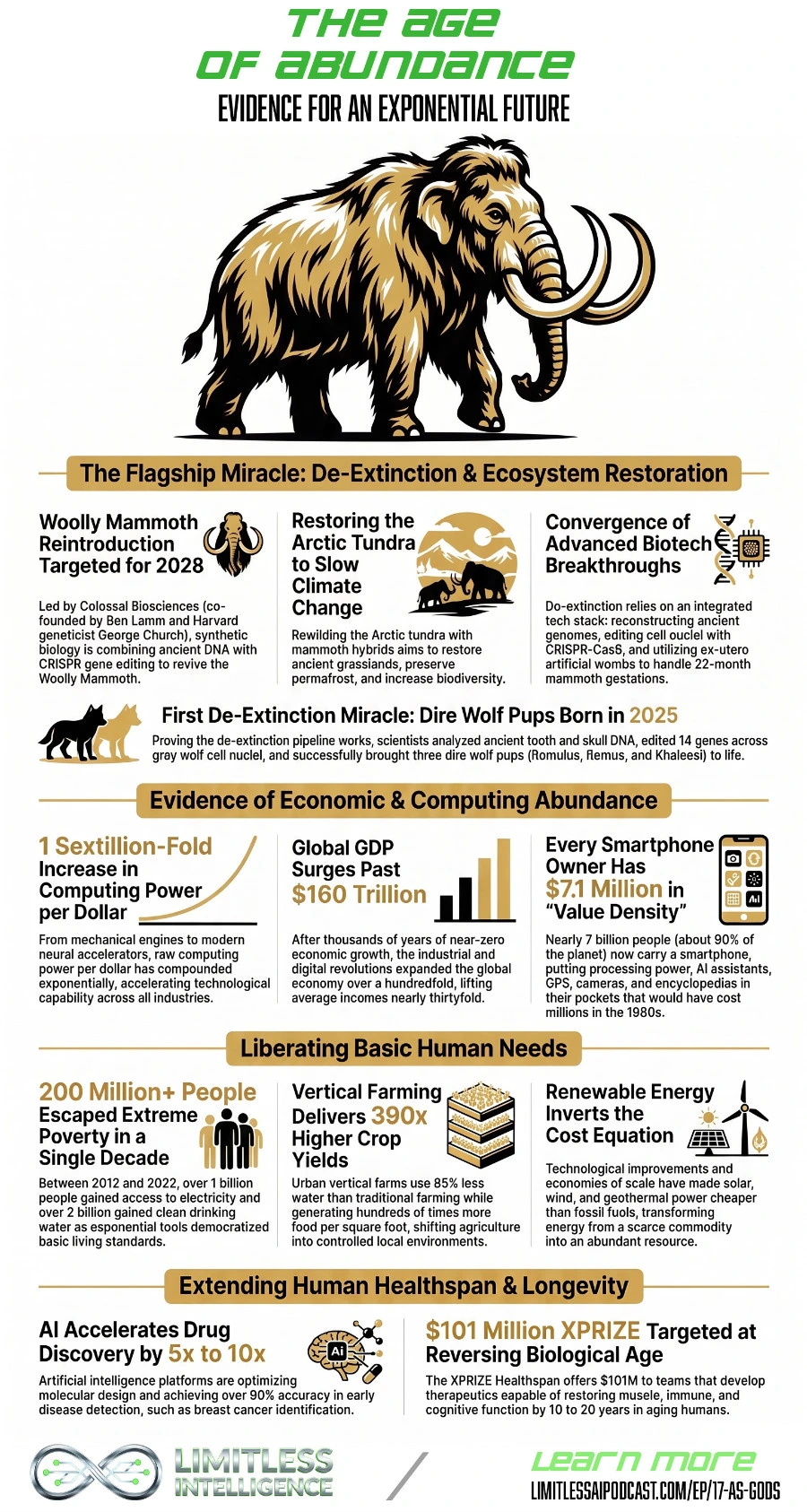
AeroFarms and Plenty move farming from the country to the city. We now grow crops in warehouses, using 95 percent less water and producing yields 390 times higher per square foot. In 2023, the industry hit $4.8 billion. By 2030, it’s projected above $33.5 billion. Israeli start-up Beewise deploys robotic beehives to combat colony collapse disorder.
You should be more worried about AI stealing your intelligence than your job
Here's why: are you guilty of cognitive offloading?
When we rely on digital tools, critical thinking skills begin to wither. This effect first showed up with memory. Once cell phones started storing phone numbers, we could no longer remember them. Then it spread to facts. Once we started to be able to look up anything we wanted to know on search engines, we stopped remembering facts—a phenomenon known as the Google effect.
The danger with AI is that we’ll offload not just memory but cognition and creativity—and, by extension, meaning itself. This is the real danger of a world of abundance.
Godlike technology demands godlike responsibility. Equally important, it demands self-control. Cognitive discipline is a prerequisite for life in the twenty-first century. If we want to hang on to thinking, learning, creating, innovating, loving, playing, and making meaning in a world of intelligent machines, we need a set of ground rules.
The authors then introduce us to The Ten Commandments for AI-Augmented Creativity. For example: 2) Thou shalt suffer for flow and 6) Thou shalt set boundaries for digital influence—Keep parts of your life untouched by algorithms so your thoughts remain your own. To take back the working memory capacity of your mind, I present the Brain Rehab Protocol in my review of The Shallows: What the Internet is Doing to Our Brains.
Here's a wild factoid
The brain takes in eleven billion bits of information a second.
I put that into my SuperMemo flashcard app of "things to remember"—a great underrated 5-minutes-a-day hack for maintaining the palace of your mind in a world that makes cognitive offloading the norm.
Blackpill: The global fertility crisis
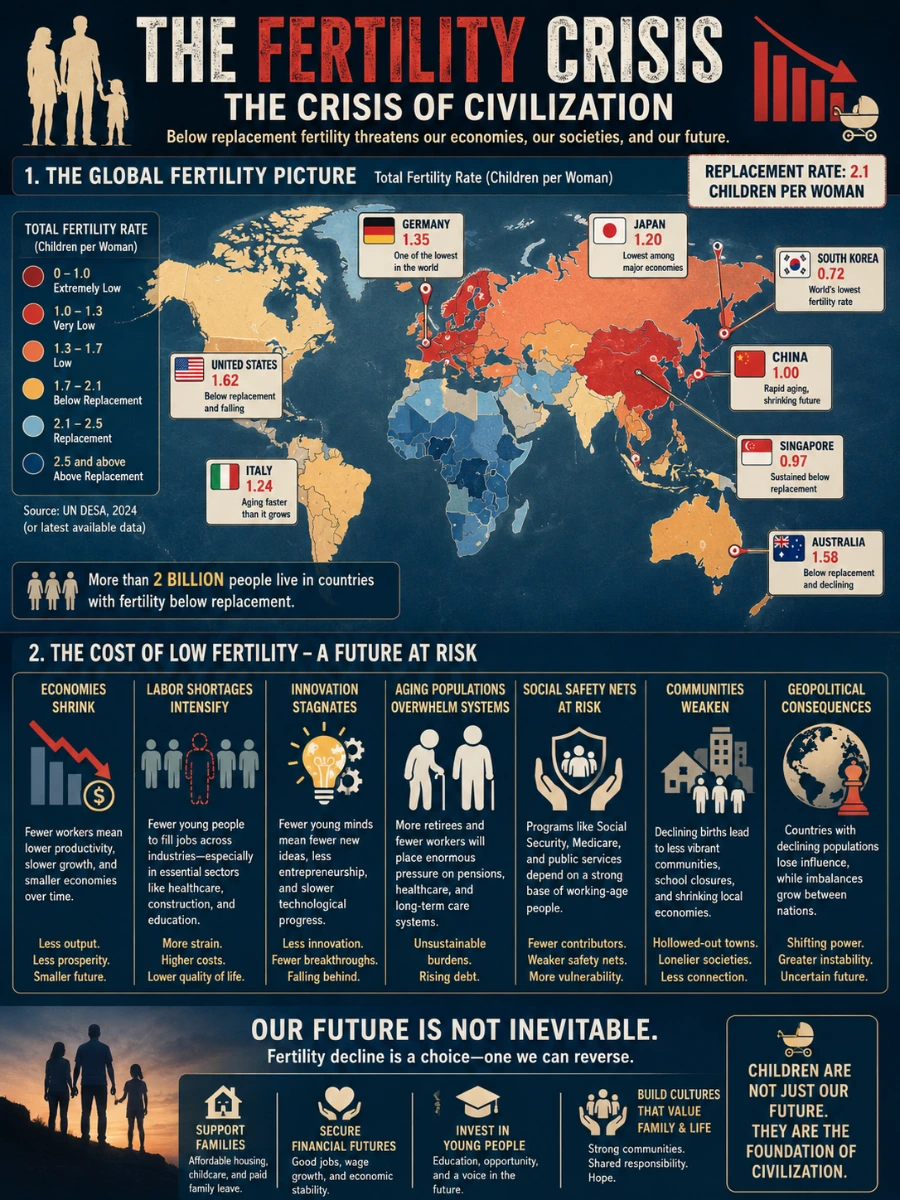
the same forces that drive economic progress also drive population decline. As societies become more resource abundant, birth rates tend to fall. Increased education, especially for women, delays childbearing, while economic opportunity shifts priorities.
On occasion, your authors have taken opposite sides of this argument—Steven arguing on behalf of the biosphere, Peter proclaiming population decline an existential risk. The truth, as usual, is more complex. The debate between overpopulation and demographic collapse has been raging for years. Some argue we have exceeded the carrying capacity of our planet’s biosphere. Others point to the vast swaths of open land available for farming while documenting the worldwide decline in birth rates. Both carry elements of the truth. The replacement birth rate is 2.1 children per couple.
declining birth rates bring their own challenges. Aging populations strain healthcare systems, social services, and pension plans. In Japan and Italy, small towns are vanishing completely. And the nations that try immigration as a solution face cultural upheavals that challenge national identities and reshape traditions.
Robots as a solution to population decline
Tesla’s Optimus, Amazon’s Digit, and Figure’s Figure 03 mark the first wave of this shift. Each of them presents solutions to the problem of population decline, which also makes them solutions to the problem of biodiversity loss. A 2023 Goldman Sachs report suggests that humanoid robots could fill up to 126 percent of the expected labor shortage in aging nations. In Japan, where nearly 30 percent of the population is over sixty-five, robots already serve as caregivers, security guards, and hotel staff. If automation can offset labor shortages, the need for population expansion fades and we can begin to balance human progress with biosphere preservation.
Robots are a lot better fix for shrinking population than mass third-world migration!
Evidence for abundance
And the evidence is abundant. The authors write: Simply stated, if standards of living are your metric, more people are living better lives than ever before in history.
The End of Energy Scarcity
Wind, solar, and geothermal power now rival or undercut fossil fuels in affordability, driven by technological improvements and economies of scale. This shift challenges the idea that clean energy is inherently more expensive, demonstrating how innovation has inverted that equation.
Venture-backed fusion start-ups now promise grid-scale reactors within the 2030s, treating the physics as solved and the challenge as one of design. This is the Silicon Valley model applied to energy’s ultimate frontier: clean, limitless power from the most abundant fuel in the universe. If even one succeeds, the era of energy scarcity ends.
The End of Food Scarcity
It takes around twelve thousand liters of water to grow a kilogram of meat. There’s enough water in an adult steer to float a US Navy destroyer.
AI and robotics transformed agriculture through precision farming and lab-grown meat, and millions no longer go hungry as a result.
To Mars
Peter thinks the first Mars mission will land around 2030, but instead of carrying humans to the new frontier, the first boots on the Red Planet will belong to a humanoid robot. They’ll set up habitats, power stations, maybe even hot tubs, making it safe and comfortable for the soft, squishy human settlers soon to arrive.
Free market space exploration for the win...
Starship represents the next inflection: an orbital freighter designed to drive costs below $100 per kilogram and carry over 100 metric tons per launch. If successful, it will enable on-orbit construction, lunar industry, and the first true supply chain between Earth and Mars.
De-extinction
In April 2025, Lamm announced the first de-extinction miracle: the return to Earth of three dire wolf pups after a twelve-thousand-year hiatus. The birth of these pups, named Romulus, Remus, and Khaleesi, was an event celebrated on the cover of Time—and for good reason. Two hundred and fifty thousand years ago, the dire wolf had a home range that stretched from Canada to South America. Extinction occurred ten to thirteen thousand years ago. All that was left behind were fossilized remains.
As far as de-extinction timelines go, Lamm believes we’ll see the first woolly mammoth by 2028, the dodo could arrive as soon as 2026, and the Tasmanian tiger even sooner. The real-life Jurassic Park? According to Lamm, unless someone finds a fully frozen dinosaur somewhere—you can’t extract DNA from fossils—that idea remains in the “too crazy for now” category. But, as Peter likes to say: “The day before something is truly a breakthrough, it’s a crazy idea.”
And the book concludes with a compendious appendix of charts which give us in black and white the tremendous trajectory of abundance. I'll mention a few...
1 Sextillion X Improvement in Computation Cost
From the gears of Babbage’s Analytical Engine to today’s neural accelerators, computing power per dollar has risen by roughly one sextillion times.
Young People Are More Depressed
I'm sure you've heard this before—Gen Zers struggle more in the mental health department, thanks largely to the internet and smartphones, and they struggled the most in the darkest days of the COVID Pandemic/Plandemic. BUT there's something revealing in the chart: depression in the youth topped out at 20% during COVID and has improved since; it's 15% now, which seems... not that bad?
Democracies Are on the Rise
By 2025, more than half the global population lives under some form of electoral democracy. The transition followed familiar signals of development—literacy, communication, and information flow.
Conflicts Are Less Deadly
What remains is a rough equilibrium: Conflict persists, but large-scale carnage has become the exception rather than the rule.
Homicides Are Way Down
The result is one of civilization’s most underappreciated achievements: a world where routine murder has become rare, and peace, for most, is the default condition.
And there are many more in the appendix--read, lest you doubt that we are moving into a post-scarcity world.
“Free humanity from drudgery”
Is an idea that Diamandis and Kotler spill a lot of ink on, and it's worthy of your cogitation.
The proliferation of humanoid robots signals a shift from one-off creations to mass production. The market is set to explode. Advances in AI, actuator technology, and battery efficiency have reduced cost by over 50 percent since 2020. Both Figure AI and Tesla have humanoid robots projected to cost around $20,000 per unit. If this price point holds, the door for widespread adoption is wide open. In logistics, widespread adoption is already here. Nearly half a million autonomous warehouse robots operate globally. By 2030, the number is likely to exceed 1.5 million. Amazon reports that robots improve operational efficiency by 40 percent, with packages moving 30 percent faster through automated facilities.
The need for human evolution
E. O. Wilson: “The real problem of humanity is the following: We have Paleolithic emotions, medieval institutions, and godlike technology.”
For most of history, evolution has been the chief driver of change, and scarcity has been the chief driver of evolution. Fitness is the term biologists use. Fitness describes how well an organism is adapted to its niche and solves the challenges of scarcity. The fitter the fit, the better the chance of survival. A plot twist: Fitness doesn’t only describe how well humans fit into the external world. It also describes the pressures that shaped our internal world. Our mental machinery evolved to navigate scarcity: to spot opportunities, dodge threats, and prioritize survival—full stop. Yet, abundance flips the script. We’ve traded paucity for plenitude but haven’t upgraded our cognitive navigation system. So how do we traverse this new territory with our old maps?
The authors ask...
If humans now have godlike powers, how do we learn to wield them with godlike wisdom?
And the place we'll turn for that is fiction...
Science Fiction: Prophecy that we will make manifest
Later in the book, the authors draw extensive comparisons between the dystopian and utopian futures, both beckoning mankind portrayed cinematically in The Matrix and Star Trek.
In The Matrix, humanity dozes in pods. In Star Trek, it dares the cosmos. The two poles of our possible future. The Matrix argues that technology without direction is a trap.
The role of science fiction in our collective shaping of the future our children and we will live in can not be overstated. This is Mindset 101: the stories we tell ourselves define how our lives will go. But The Matrix and Star Trek really don't give you much pragmatically that you can do to play your part in getting to a utopian future. For that, I'll direct your attention to two lesser-known works of science fiction that really deserve a place on your reading list. First, The Future by Stefan Molyneux is a realistic and profoundly optimistic vision of an anarcho-libertarian future of peace and abundance. If you listened to libertarians and thought, "But how would a society with governments actually work?" The Future delivers (hint: it has a lot to do with nonviolent parenting). And then, there's my cyberpunk thriller novel series, Hourglass, about a Biohacking cybercriminal who must save civilization from the same comet that destroyed Atlantis 12,800 years ago.
It asks a wild question: what if the sexual sovereignty of the individual mirrors driving cosmic cycles of civilizational cataclysm? And then gets dangerously pragmatic with over a hundred footnotes into fringe consciousness science and Biohacks for reclaiming your divine right to free will. Here's a passage from the book...
“Are you familiar with Fermi’s Paradox?” Brousseau asked.
Xavier tilted his head. “Somewhat.”
“Then you know that statistically speaking, intelligent life should have evolved on billions of planets throughout the galaxy. And yet, we encounter none.”
“Because space is too big?” Astrid asked.
Brousseau shook his head. “Because, most likely, those alien civilizations annihilated themselves before they could achieve interstellar travel. They created technology - perhaps something like ours - that they couldn’t control. Weapons too powerful. Forces they didn’t understand.” He let the thought hang for a moment, then sighed. “I fear that may be what’s happening at CERN at this very moment.”
Xavier rubbed his chin. “You’re saying that we’re about to hit the Great Filter? That Quantum Dynamics and CERN are pushing us into the final mistake?”
The Solution: Biohacking
This coolest addition to the thesaurus broadly means: the marriage of personal growth and health, with an emphasis on longevity and optimizing human performance.
I entitled this review: The Age of Abundance is for the Avaricious—and that's my conclusion from the book. It will never be a better time to be a high-agency human, willing to wrangle back your own free will via a combination of an aggressive growth mindset and Biohacking to better your human intelligence. But here's where we get real Ayn Randian: the masses of unthinking conformists, consumers, and comfort zone stay-putters—they are going to have a rough time in the age of abundance. I put this less eloquently in a tweet...
Just finished "We Are As Gods." My takeaway: Life will NEVER be better for adaptive, entrepreneurial people with a serious growth mindset. But (and THIS is a BIG BUT... Bigger than any that you might find a thong on a beach in Brazil): Normies are royally fucked in the age of abundance. The people who want to work a 9-5, conform to whatever bullshit values society pretends to have, then crash in front of the TV and drink a beer. The people who just don't want to think THAT hard about life and would rather spend their money on a Netflix subscription than take NMN. They are FUCKED--And that's MOST people. Scary.
— Jonathan Roseland (@JRoseland) October 7, 2026
But before you start attaching PEMF devices to your head, quit your job, and refuse to pay taxes—there are 5 mindsets the authors name for surviving and thriving in the abundance era...
- The Curiosity Mindset
- The Abundance Mindset
- The Longevity Mindset
- The Exponential Mindset
- The Moonshot Mindset
If you've followed my work for long, you're no stranger to these mindsets. Mindset might seem like a flimsy feel-good solution to technological unemployment, the threat of human extinction by AI, and other substantial worries we hold, but the authors remind us...
The moment we start believing the future is happening to us rather than being created by us, we surrender agency. In formal language, we adopt an external locus of control. In less formal terms? A victim mindset.
CHAPTER EIGHT The Androids Are Us goes beyond Biohacking tech and suggests that Brain enhancement is for speed while Consciousness-raising is for scale. And suggests the most human of tools: flowstate.
Let's look a little closer at a topic that has been central to my work and personal obsession for going on a decade now...
Longevity Mindset
Stanford psychologist Alia Crum discovered that having a positive mindset toward aging—that is, believing your best days are ahead of you—translates into an extra seven and a half years of life. That’s the same gain a heavy smoker gets by quitting. The data is clear: how we think about aging changes how we age. To cultivate a longevity mindset, you need to think and act as if aging is a modifiable process and not an inevitable decline. But this demands more than optimism. It requires action: taking ownership of your health and staying abreast of emerging therapies.
a host of converging technologies, from AI and CRISPR to gene therapies and cellular medicine, are about to add healthy decades to our lifespans. More critical is the follow-on realization that the most important action one can take to intercept this healthspan extension is to maintain peak health today. This, then, is the longevity mindset: the belief that lifespan is more malleable than we once imagined, and that the right technologies can meaningfully extend our healthy years. In this view, aging is an opportunity. What would you do with fifty more years? A hundred?
This is a question that's really deserving of your contemplation. You might, very well, live much longer than your parents could hope to. You face the real possibility of spending a hundred, perhaps hundreds of years on this planet. So what should you be doing now to ensure those years are pregnant with joy and meaning, not made bland by the vicissitudes of repetitive mundanity? That's a question deserving of one of my favorite lifehacks for deep self-reflection: go for a stroll in a cemetery WITHOUT your smartphone and just think about your life.
 Lifehack: spend 30 minutes strolling a cemetery without your smartphone and just think about your life
Has the first immortal been born?
We’re nearing what Ray Kurzweil called longevity escape velocity, which is the moment when medical progress outpaces biological decay, extending our healthy lifespan faster than time erodes it. Once theoretical, longevity escape velocity is now measurable. With AI accelerating every aspect of longevity research, the slope of that curve is bending upward.
Consider the $101 million XPRIZE Healthspan, which is maybe the most ambitious XPRIZE yet. To win, you need a therapeutic treatment that reverses the ravages of aging in muscle, immune, and cognitive function by a minimum of ten years, and with a real goal of twenty. In other words, give humanity back two healthy decades, win a hundred and one million dollars.
Conclusion: The age of abundance appraised accurately

I don't flippantly dole out 5-star reviews, but We Are As Gods deserves it. It delivers the dose of optimism we all need about the future, which we expect from the likes of Diamandis and Kotler. But it also seriously appraises the appreciable downsides of abundance. I've read a few of Kotler's other works, and he is a master of the pen, like those; this is a pleasure to read. The book is not "the world, according to the authors"—they bring an abundance of evidence and data (with 41 pages of footnotes) supporting their conclusions. And, finally, in the book's latter half, it gets pragmatic with the five mindsets for the Age of Abundance and The Ten Commandments for AI-Augmented Creativity.
As I draw toward the end of this review, a call to action you weren't expecting...
Make babies or regret it BIGLY
Here's why...
It’s an abundance of life to go with our life of abundance, and it raises a final concern: meaning. If death is less of a deadline, we face a different problem: not how to stay alive but how to stay human.
Because...
Without curiosity, creativity, play, purpose, flow, and meaning, our brains atrophy and our minds rot.
Raising children or grandchildren gives you these things, in abundance.
If you're the kind of person reading this, the world really needs your kind of genes. And you're also the kind of person that's probably going to take advantage of all those mind-blowing advances in longevity—hundreds of years is a long time to spend without the joy of children in your life. Entrepreneurship, travel, intellectual pursuits, and VR games are no substitute for the visceral wonder and awe that children will infuse you with. So, do it like do it on the Discovery Channel! Or do your damnest to get involved as an aunt, uncle, or "Mr. Rogers" character in your community.
We Are As Gods inspired this song about the age of abundance...
Finally...
Join the Limitless Intelligence Newsletter to...
Never miss a new episode, and get ahead of the AI curve. This informative (and often entertaining!) newsletter is about how to take advantage of the latest tools, and where I dispense timely tips, hacks, and my own musings.Don't worry! This just signs you up for our informative weekly newsletter (actually worth reading), NOT an aggressive automated marketing machine.

 on twitter